Handbook study course › Safe and Responsible Driving
Parking along roadways
Where you may not park, how far to stay from hydrants, intersections and crossings, parallel parking and parking on hills.
25 key points from this part of the handbook. Read them, then practise; every point comes from the explanation of one of our practice questions.
- At an intersection controlled by traffic lights, do not park within 15 m. At other intersections the distance is 9 m.
- Do not park within 15 m of the nearest rail of a level railway crossing. Do not confuse this with stopping for a train, where you stop at least 5 m away.
- At an intersection with traffic lights, you must not park within 15 m. The 9 m distance is for intersections without lights, so 10 m would be legal only there.
- Facing uphill with a curb, turn the steering wheel left so the wheels point toward the road. If the vehicle rolls back, the back of the front tire will catch on the curb.
- Facing uphill without a curb, turn the wheels sharply to the right. If the vehicle rolls back, it will roll off the road instead of into traffic.
-
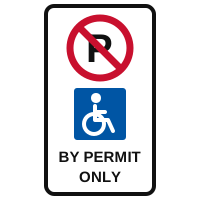 Never park in a space for people with disabilities unless you display a valid Accessible Parking Permit, even for a short time.
- Normally you signal before slowing down. But if a vehicle is waiting to enter from a driveway or side road before your stopping point, wait until you pass it, or the driver may think you are turning in there.
-
The permit belongs to the person, not the vehicle. Any vehicle may use the space only while carrying the permit holder.
- Do not park within 3 m of a fire hydrant. Firefighters need clear, quick access to it.
- Do not park within 9 m of an intersection. If the intersection has traffic lights, the distance is 15 m.
- Look for a space about one and a half times the length of your vehicle. This gives you enough room to back in safely.
- You must not park within 3 m of a fire hydrant, so 2 m is too close. Firefighters need quick, clear access to it.
- Stop parallel to the curb and no more than about 30 cm away. This keeps your vehicle out of the traffic lane.
- Never park on a curve or hill, or anywhere you do not have a clear view of at least 125 m in both directions. Drivers coming over the hill would have too little time to see your vehicle.
- Parking is not allowed on a bridge or within 100 m of one, so 50 m is too close. Find a legal place to stop farther away.
- Do not park on a bridge or within 100 m of it. A parked vehicle there blocks traffic where drivers have little room to go around.
- Do not park within 6 m of a public entrance to a hotel, theatre or public hall while it is open to the public. This keeps the entrance clear for people and emergency access.
- Never park where you do not have a clear view for at least 125 m in both directions. Other drivers need time to see your vehicle and avoid it.
- Never park or stop on the travelled part of the road. If you must stop, pull off onto the shoulder so traffic can pass safely.
- When facing downhill, turn your front wheels toward the curb or right shoulder. If the vehicle rolls, the curb or shoulder will stop it instead of letting it roll into traffic.
- Park parallel to the curb on the right side of the road, facing the direction of traffic, unless signs allow angle parking. On one-way roads you may park on both sides unless signs say otherwise.
- Never leave children or animals alone in a parked vehicle. When you leave, turn off the engine and lights, take the key and lock the vehicle.
- An Accessible Parking Permit may be used only when the permit holder is the driver or a passenger. Misusing a permit can lead to fines and loss of the permit.
- After a roadside stop, turn off your turn signal and turn on your hazard lights. This warns other drivers that your vehicle is stopped.
- Do not park where you block a crosswalk, pedestrian crossing, sidewalk or road entrance. Pedestrians need a clear path at all times.