Handbook study course › Safe and Responsible Driving
Freeway driving
Entering and leaving a freeway, merging, keeping your speed and space, and passing safely at highway speed.
19 key points from this part of the handbook. Read them, then practise; every point comes from the explanation of one of our practice questions.
-
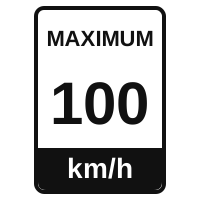 On freeways, keep to the right and use the left lanes for passing. After passing, do not stay in the far left lane.
-
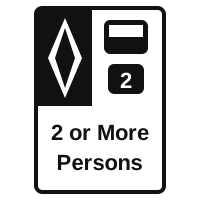 Most vehicles need at least 2 people in an HOV lane, but licensed taxis and airport limousines may use it with only the driver.
-
On provincial highways, HOV lanes are for vehicles carrying at least two people, plus some exempt vehicles such as buses.
-
Commercial vehicles need two or more people and must be less than 6.5 m long to use an HOV lane. Large trucks are never allowed.
- Use the left lane for passing, but do not stay there. Drive in the right lane whenever you can so faster traffic can get by.
- Use the acceleration lane to bring your speed up to that of freeway traffic, signal, and merge smoothly into a safe gap.
- Never stop or back up on a freeway. If you miss your exit, carry on and take the next one.
- A freeway exit has a deceleration lane, an exit ramp and an intersection controlled by a stop sign, yield sign or traffic light. Be ready to stop at the end of the ramp.
- Traffic keeps right. Use the left lanes for passing, do not stay in the far-left lane, and drive in the right lane when you can.
-
Buses can use an HOV lane at any time, no matter how many people are on board.
- After driving fast for a long time, you can lose your sense of speed (speed adaptation or "velocitization"). Check your speedometer and slow to the speed shown for the ramp.
- Signal and move into the deceleration lane without slowing down on the freeway, then reduce speed gradually to the posted ramp speed.
- If it is safe, move over to make room for vehicles entering the freeway. Keep a steady speed and leave space around your vehicle.
- On the entrance ramp, look ahead, check mirrors and blind spots, and judge traffic. In the acceleration lane, bring your speed up to that of freeway traffic, signal, and merge smoothly.
-
HOV lanes on provincial highways are open 24 hours a day, seven days a week, so the occupancy rules always apply.
- Some ramps join on the left, putting you straight into the fastest lane. Use the acceleration lane to reach the speed of traffic, accelerating more quickly than usual.
- After driving at high speed, slower speeds feel slower than they really are. This is called speed adaptation or velocitization, so check your speedometer and slow to the posted ramp speed.
-
Crossing the striped buffer is illegal and unsafe. Enter and leave the HOV lane only at the designated zones.
-
Large trucks are not allowed in provincial HOV lanes, no matter how many people are on board. Buses and motorcycles may use them.