Handbook study course › Safe and Responsible Driving
Changing directions: turns
Signalling, right and left turns, turning on a red light, and turning around safely.
25 key points from this part of the handbook. Read them, then practise; every point comes from the explanation of one of our practice questions.
- Keep your wheels straight until you start the turn. If you are hit from behind with your wheels turned left, you could be pushed into oncoming traffic.
- Even when the road is clear, you must come to a complete stop before turning right on a red light, then turn when the way is clear, unless a sign prohibits it.
- Both lanes may be used to go straight. The left lane is also for left turns and the right lane for right turns; stay in the lane you entered until you exit.
-
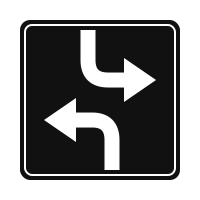 A two-way left-turn lane is for left turns from both directions. It must not be used for passing.
-
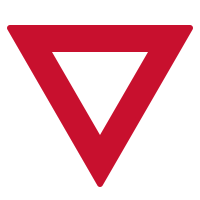 At a roundabout, traffic already circulating has the right-of-way. Look left and enter only when there is a safe gap.
- A left turn on red is allowed only from a one-way road onto a one-way road, after a complete stop and when the way is clear.
- A left turn on red is allowed only from a one-way road onto another one-way road. Onto a two-way road, you must wait for a green light.
- When turning left from a two-way road onto a one-way road, turn from the lane closest to the centre line into the left curb lane. This keeps your turn short and out of the way of other traffic.
-
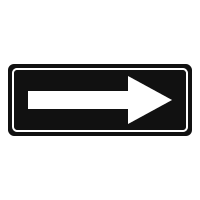 A left turn on a red light is allowed only from a one-way road onto a one-way road. You must stop completely first and yield to pedestrians and other traffic.
- Never make a U-turn unless you can see at least 150 m in both directions, and check first that no sign prohibits it.
- It is illegal to reverse on a divided road with a speed limit over 80 km/h, on the road or the shoulder, unless you are helping someone in trouble.
-
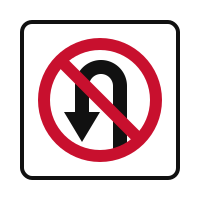 Before a U-turn, check there is no sign against it, and make sure you can see at least 150 m both ways.
- Before turning right, check your right blind spot and let cyclists, mopeds and limited-speed motorcycles go through the intersection first.
- In Ontario you may turn right on red unless a sign says otherwise, but only after a complete stop and after yielding to pedestrians and traffic.
- U-turns are illegal where your view is limited: on a curve, on or near a railway crossing or hilltop, or near a bridge or tunnel that blocks your view.
- When reversing, move slowly and turn your body and head to see where you are going, checking especially for children and cyclists.
- Once in a roundabout, always keep to the right of the central island and travel counter-clockwise.
- Traffic in the roundabout has the right-of-way. When entering, watch vehicles on your left, and slow down or stop at the yield sign if needed.
- A right turn on red is allowed only after a complete stop and only when the way is clear. You must yield to pedestrians and other road users first.
- Begin and end a right turn close to the right side of the road, completing it in the right-hand lane of the road you are entering, unless signs or markings say otherwise.
- Choose your lane as at any intersection: the right lane to turn right or go straight, the left lane to turn left or go straight.
- Turn from the lane closest to the centre line into the lane just right of the centre line. Move over to the right lane later when it is safe.
- Drivers from both directions share this lane only to slow down and make left turns. Never use it for passing.
- Use the left lane to turn left or go straight, and the right lane to turn right or go straight. Do not enter from the right lane if you want to turn left.
- Bicycles, mopeds and motorcycles turn left just like other vehicles. Do not pull up beside one to turn at the same time; stay behind it and wait for it to move right before you pass.