Handbook study course › Safe and Responsible Driving
Stopping
Where to stop at intersections, stopping for school buses, at railway crossings and behind streetcars, and stopping safely.
30 key points from this part of the handbook. Read them, then practise; every point comes from the explanation of one of our practice questions.
Stopping
-
 Wait until signal lights stop flashing and the gate is fully raised. Never drive around, under or through a gate that is down, lowering or rising.
-
Never drive around, under or through a railway gate while it is down. A train may be closer and faster than it looks.
- Unless the road has a median, drivers from both directions must stop for a school bus with its red lights flashing.
- At a pedestrian crossover, drivers must stop and yield the whole roadway. Go only after the pedestrian is safely on the sidewalk.
- Avoid stopping on railway tracks. Before you start across, make sure there is enough room on the other side to clear the crossing completely.
-
 Stop at the stop line if there is one. If not, stop at the crosswalk; if there is no crosswalk, at the edge of the sidewalk; if no sidewalk, at the edge of the intersection.
-
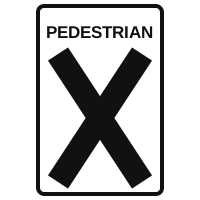 At a pedestrian crossover you must wait until pedestrians (and any crossing guard) have completely crossed the road and are safely on the sidewalk.
-
With no stop line, crosswalk or sidewalk, stop at the edge of the intersection. Then wait until the way is clear.
- On a road with a median strip, only vehicles coming from behind the bus must stop. Oncoming drivers should still watch for children.
- The school bus law applies on any road, whatever the number of lanes or speed limit, at any time of day. Without a median, traffic in both directions must stop.
-
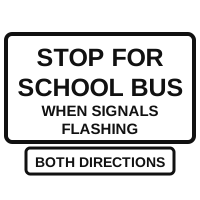 You must stop for a school bus with flashing red lights on any road, regardless of the number of lanes or the speed limit, at any time.
-
On a road with a median strip, only vehicles coming from behind the bus must stop. Without a median, traffic from both directions stops.
- When coming from behind a stopped school bus with red lights flashing, stop at least 20 m away so children can get on or off safely.
- You must not pass any vehicle within 30 m of a pedestrian crossover, because the vehicle you pass may be stopping for a pedestrian you cannot see.
- If a train is coming, stop at least 5 m from the nearest rail or gate, and do not cross until you are sure all trains have passed.
-
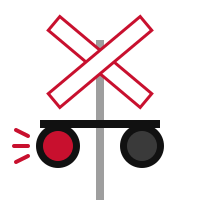 Flashing lights mean a train is coming. Stop at least 5 m from the nearest rail or gate and wait until the lights stop flashing; never drive around, under or through a lowered gate.
-
When approaching from behind, stop at least 20 m from the bus. Do not go until the bus moves or the lights stop flashing.
- Failing to stop for a school bus with red lights flashing can bring a heavy fine and 6 demerit points for a first offence.
-
If a train is coming, stop at least 5 m from the nearest rail or gate. Do not cross until the train has passed and it is safe.
- Never drive around, under or through a railway gate while it is down, being lowered or being raised. Wait until it is up and the lights stop.
- At any railway crossing, slow down, listen and look both ways. If a train is coming, stop at least 5 m from the nearest rail.
- It is illegal and dangerous to drive around, under or through a railway gate while it is down, being lowered or being raised.
- At a railway crossing with a stop sign, you must stop unless a flagman directs you otherwise. Look both ways and cross only when it is safe.
-
Pedestrian crossovers are designated areas that let pedestrians cross roads safely where there are no traffic lights.
- Stop at the stop line if there is one. If not, stop at the crosswalk; with no crosswalk, at the edge of the sidewalk; with no sidewalk, at the edge of the intersection.
Driving near railway crossings
-
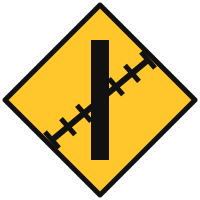 Another train may follow or come from the other direction. Cross only when you are sure every train has passed.
-
Stop at least 5 m from the nearest rail or gate, and wait until the train has passed and it is safe.
-
Changing gears on the tracks could stall the engine and leave you stuck. Choose your gear before you reach them.
-
Never stop on railway tracks. Cross only when there is space for your entire vehicle on the other side.
-
School buses must stop at all railway crossings. Be ready to stop behind the bus.