Handbook study course › Traffic Signs and Lights
Traffic signs and lights
Regulatory, warning, temporary and information signs, traffic lights, pedestrian signals and pavement markings: part 1 of the G1 test.
105 key points from this part of the handbook. Read them, then practise; every point comes from the explanation of one of our practice questions.
Signs
-
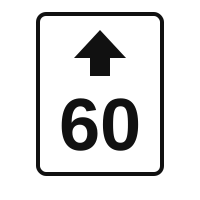 The arrow above the number warns that a new speed limit begins ahead. Be ready to adjust your speed.
-
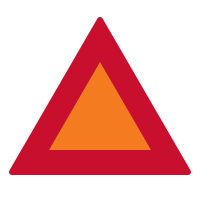 This orange triangle with a red border is the slow-moving vehicle sign. Farm tractors and other vehicles that cannot keep up speeds over 40 km/h must show it; construction signs are usually orange diamonds.
-
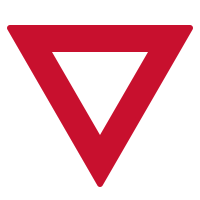 A yield sign means other traffic goes first. Slow down, stop if you need to, and go only when the way is clear.
-
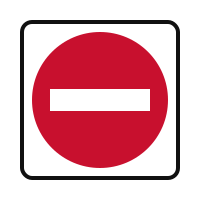 This sign means you must not drive into the road. It is often placed where entering would mean driving the wrong way.
-
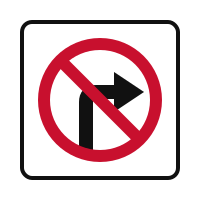 The red circle and slash over a right arrow means right turns are not allowed here, whatever colour the light is.
-
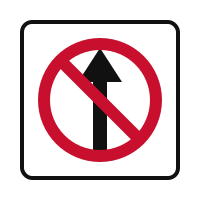 The red circle and slash over an upward arrow means you may not go straight through this intersection.
-
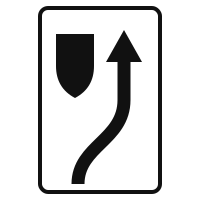 This sign is placed at a traffic island or divider. Drive on the right side of it.
-
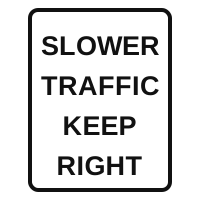 Slower traffic keeps right so faster vehicles can pass on the left.
-
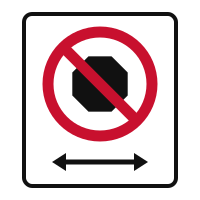 No stopping is the strictest of these signs. You may not stop your vehicle in the area at all, even briefly.
-
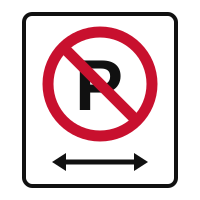 No Parking means you may not leave your vehicle parked here. Brief stops to load or unload passengers or merchandise are allowed.
-
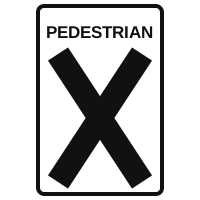 This sign marks a pedestrian crossover (PXO). Drivers must be ready to stop and give pedestrians the right-of-way.
-
 The white X with a red border marks a railway crossing. Slow down, look both ways for trains and be prepared to stop.
-
This sign does not tell you to stop. It means you may not stop your vehicle between the signs, even for a moment.
-
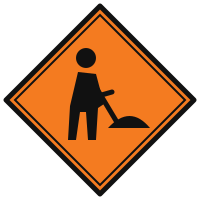 A worker with a shovel on an orange sign means people are working on the road ahead. Slow down and watch for workers and equipment.
- In a no-stopping area you may not stop at all, not even briefly. A no-standing area lets you stop only to load or unload passengers.
- A community safety zone sign marks a special risk to pedestrians, and traffic offences there carry increased fines. A school zone sign tells you to slow down and watch for children.
- The lower school zone limit applies when the yellow lights are flashing during school hours. When they are not flashing, obey the regular posted limit and still drive with care.
- In a no-standing area you may stop only to load or unload passengers. In a no-stopping area you may not stop at all, and in a no-parking area you may also load or unload merchandise.
-
At a yield sign you must stop only when needed to let others go first. If the way is clear, you may continue with care.
-
This sign gives advance notice that the speed limit changes ahead. Adjust your speed so you obey the new limit when you reach it.
-
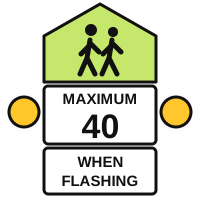 This school zone sign shows a reduced limit for school hours. It is in effect when the yellow lights are flashing.
-
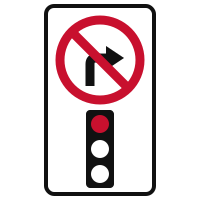 Normally you may turn right on red after a full stop. This sign removes that permission at this intersection.
-
This sign prohibits right turns only while you face a red light. On a green light, you may turn right as usual, yielding to pedestrians.
-
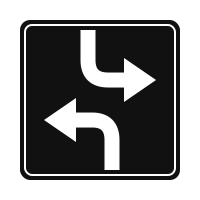 This lane lets left-turning drivers from either direction wait for a gap without blocking through traffic.
-
Between No Stopping signs you may not stop at all, not even to pick up a passenger. Find a legal place to stop instead.
Warning signs
-
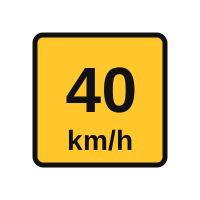 The tab shows the maximum safe speed for the curve. On snow, ice or wet pavement you may need to go slower still.
-
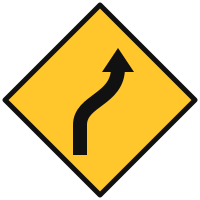 A curved arrow warns of a slight bend in the road. A right-angle arrow would warn of a sharp turn instead.
-
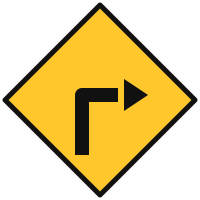 The right-angle arrow means the road turns sharply. Slow down more than you would for an ordinary curve.
-
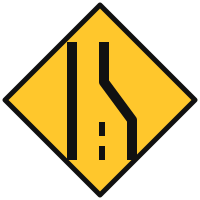 The right edge line bends in to meet the lane beside it. Drivers in the right lane must merge left.
-
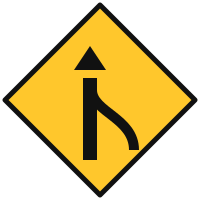 The curved line joining the straight arrow shows traffic from another road entering yours. Expect vehicles to merge.
-
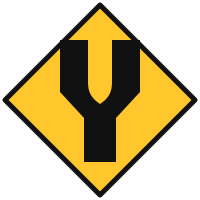 The road splits around a median at the top of the symbol. Ahead, each direction has its own one-way road.
-
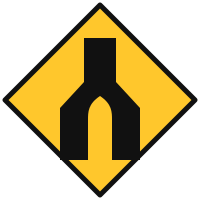 The median ends at the top of the symbol. Ahead, traffic in both directions shares one road with no median.
-
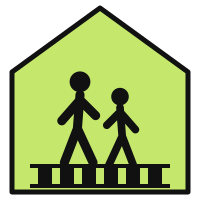 The crosswalk under the children marks a school crossing. Watch for children and follow the crossing guard's directions.
-
Each road of a divided highway is one-way. Keep to the right, so the median is on your left.
-
This is the curve sign: the bend is gradual. Still slow down before the curve, not in it.
-
A sharp turn needs a much lower speed. Brake before the turn so you can steer through it smoothly.
-
When your lane ends, it is your job to merge. Check mirrors and blind spot, signal, and move over smoothly.
-
On a divided highway a median separates the two directions. Keep to the right of the median.
-
When the divided highway ends, nothing separates you from oncoming vehicles. Keep right and do not drift over the centre line.
-
At a school crossing, children may step out at any time. Follow the directions of the crossing guard or school safety patroller.
-
Brake before the curve, not in it. Hard braking while turning on a wet road can make the vehicle skid.
-
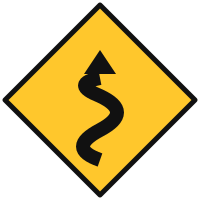 The snake-shaped arrow means several curves in a row. Keep a lower speed for the whole section, not just one bend.
-
Drivers in the right lane must merge left. Help them by keeping a steady speed and leaving a gap.
-
Drivers on both roads share the job of merging smoothly. Make room when you safely can.
-
When the divided highway ends, both directions share one road. Keep right and stay well within your lane.
-
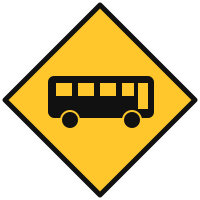 Buses may pull onto the road from the entrance ahead. Slow down and be ready to let them in.
-
Where two roads join, drivers on both roads share responsibility. Adjust speed and leave space so traffic can merge.
-
This is the merge sign, not the lane-ends sign. Your lane continues, but vehicles from the other road will move in beside you.
-
Soon the left side of the road will carry oncoming traffic. Return to the right lane in good time and keep right.
-
A school crossing sign shows a crosswalk under the children. Expect children to cross at this point, often with a crossing guard.
Traffic lights
-
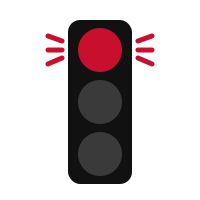 A flashing red light works like a stop sign. Stop completely, then go when the way is clear; it will not turn green.
-
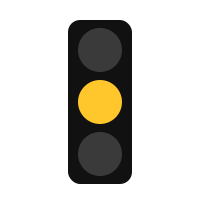 A yellow light means stop if you can do so safely. Speeding up to beat the red light is dangerous and can end with you running the red.
-
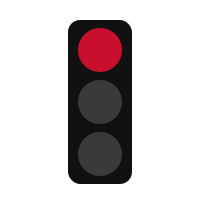 In Ontario you may turn right on a red light, but only after a complete stop and once the way is clear. A sign can prohibit it.
-
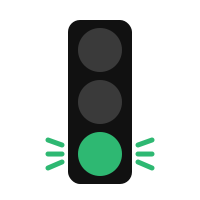 A flashing green light is an advance green. You may turn left, go straight or turn right from the proper lane while oncoming traffic faces a red light.
- When signals are dark, proceed carefully as at an all-way stop. Yield to vehicles already in the intersection and to vehicles entering from your right.
-
A flashing green light is for drivers, and oncoming traffic faces a red light. Pedestrians must not cross on it unless a pedestrian signal tells them they may.
-
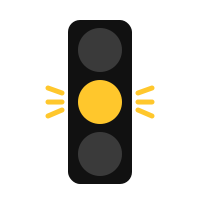 At a flashing yellow light, drive through with caution; you do not have to stop. At a flashing red light, come to a complete stop, then go when it is safe.
-
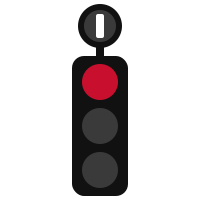 A white vertical bar on a transit priority signal lets transit vehicles go while other traffic faces a red light. Stay stopped and yield to the transit vehicle.
-
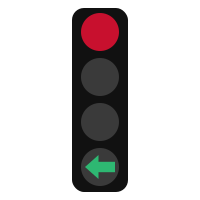 A red light with a left-turn green arrow allows left turns only, from the left-turn lane. Traffic going straight still faces a red light and must wait.
-
At a flashing red light, stop completely and then go when the way is clear. At a steady red light you must wait for green, except for a permitted turn after stopping.
- When traffic lights are out, treat the intersection like an all-way stop: stop, then yield to vehicles in the intersection and to vehicles entering from your right.
- On a green light you may go only after yielding to vehicles and pedestrians who are already in the intersection.
-
A steady red light means a complete stop at the stop line. To go straight, you must wait until the light turns green and the intersection is clear.
-
A yellow light warns that red is coming. Stop if you can do it safely; if you are too close to stop safely, go through with caution.
-
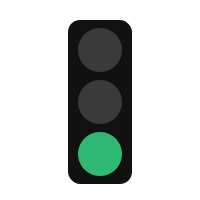 A green light lets you go straight or turn, but you must still yield to vehicles and pedestrians already in the intersection, and to pedestrians crossing when you turn.
-
A flashing yellow light does not require a stop. Slow down, watch for other traffic and drive through with caution.
-
Yellow means red is coming. If you are already in the intersection, or too close to stop safely, go through with caution; stopping or backing up there would create a hazard.
-
At a flashing red light, come to a complete stop and go only when it is safe, just as you would at a stop sign.
-
This is a simultaneous left turn: drivers in the left-turn lane may turn left, and drivers coming the other way may be turning left at the same time. Straight-through traffic still has a red light.
-
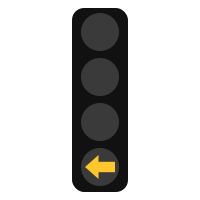 A yellow arrow means a green light is about to appear for other traffic. Don't begin a left turn; stop if it is safe, or complete the turn with caution if you cannot stop.
-
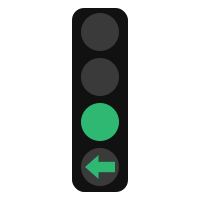 Even on an advance green, you must yield to pedestrians already in or approaching your path. Pedestrians should not start crossing on this signal, but anyone still crossing must be allowed to finish.
-
A flashing yellow beacon can be placed above an intersection, a warning sign or an obstruction. It means drive with caution.
-
After the arrow ends, a green light lets you turn left only when the way is clear of traffic and pedestrians. Oncoming traffic may now have a green light too.
- If the light turns red while you are already in the intersection, finish your left turn once oncoming traffic has stopped and the way is clear. Do not back up.
- With separate left-turn signals, you may not begin a left turn after straight-through and right-turning traffic gets its green light. Wait for your next green arrow.
Pavement markings
-
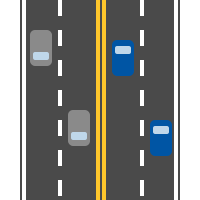 Yellow lines separate traffic going in opposite directions. White lines separate lanes of traffic going the same direction.
-
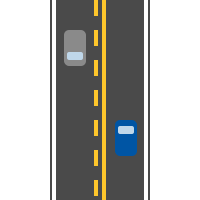 A solid line at the left of your lane means passing is unsafe there. You may pass only where the line on your side is broken and the way is clear.
-
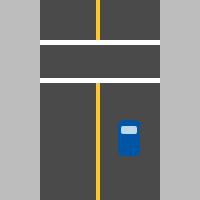 With no stop line, you stop at the crosswalk, marked or not. With no crosswalk, stop at the edge of the sidewalk, or at the edge of the intersection if there is no sidewalk.
-
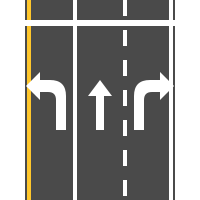 A lane arrow means you may move only in the direction it shows. If you end up in the wrong lane, follow the arrow and choose a new route instead of making an unsafe move.
-
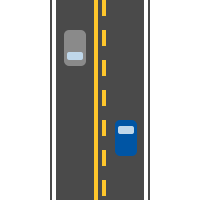 A broken line at the left of your lane means you may pass, but only when the way ahead and the oncoming lane are clear.
-
Lane arrows are rules, not advice. Get into the lane whose arrow matches where you want to go before you reach the intersection.
-
White lines separate lanes of traffic going the same direction. Yellow lines separate traffic going in opposite directions.
-
Each lane arrow shows the only direction allowed from that lane. Here the left lane is for left turns, the middle lane for going straight and the right lane for right turns.
-
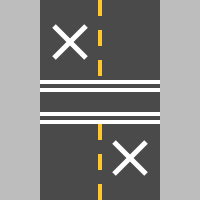 These markings identify a pedestrian crossover (PXO). Drivers and cyclists must stop before the line and wait until pedestrians have completely crossed the road.
- These are continuity lines. On your right, they mean your lane continues unaffected. On your left, they mean your lane is ending or exiting.
- Painted lines like these guide traffic away from fixed objects such as bridge piers or concrete islands. The object itself may also have yellow and black warning markings.
-
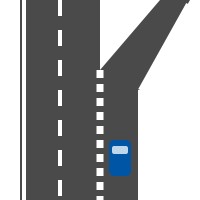 These are continuity lines. On your left, they mean your lane will end or exit, so move over to continue straight. On your right, your lane carries on.
-
Each driver follows the line on their own side. The grey car has a broken line on its side, so its driver may pass when the way is clear; the solid line on the blue car's side means passing is unsafe for the blue car.
Pedestrian signals
-
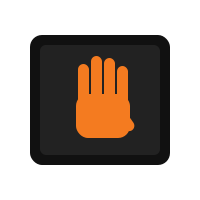 The orange hand tells pedestrians not to start crossing. Anyone already crossing should get to safety quickly and still has the right-of-way, so you must wait.
-
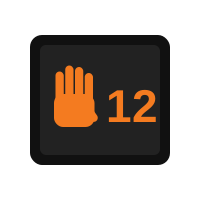 The countdown shows the time left for people already crossing. While the orange hand is shown, pedestrians must not start to cross, however many seconds remain.
-
A flashing or steady orange hand both mean pedestrians must not begin to cross. Anyone already crossing should go to a safe area quickly and still has the right-of-way.
-
A countdown signal shows how many seconds remain to finish crossing. While the orange hand is shown, pedestrians must not start to cross, and drivers should expect people still in the crosswalk.
-
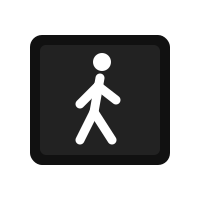 A pedestrian crossing on the walk signal has the right-of-way over all vehicles. Wait until the pedestrian has passed before you turn.
- Where push-buttons are provided, pedestrians must press the button to bring up the walk signal. The signal then stops main-road traffic so they can cross.
- Where there are no pedestrian signals, pedestrians facing a green light may cross. They may not cross on a flashing green light or a left-turn green arrow.
- An intersection pedestrian signal has traffic lights for the main road only, plus crosswalks, walk signals and push-buttons. Traffic on the smaller crossroad is controlled by stop signs.
Signs (information and direction signs)
- A yellow EXIT box on an advance sign means one or more lanes leave the freeway. If you stay in such a lane you will have to exit, so move over early if you want to keep going.
- Freeway interchange numbers match the distance in kilometres from the start of the freeway. Subtract one number from the other: 282 − 250 = 32 km.
-
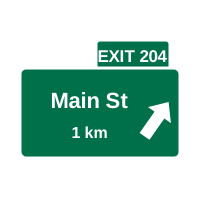 Interchange numbers match the distance from the start of the freeway. For example, interchange 204 on Highway 401 is 204 km from Windsor, so subtracting two exit numbers gives the distance between them.
-
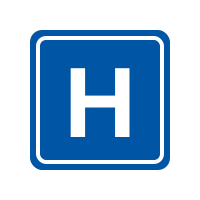 Information signs like this guide you to off-road facilities such as hospitals, airports, universities and carpool lots.
- VIA signs show the roads to follow to reach a destination. Here, take Highway 7 to get to the city named on the sign.
- Changeable message signs give up-to-date information on delays and lane closures. Read them early so you have time to slow down or change lanes.
Regulatory signs
-
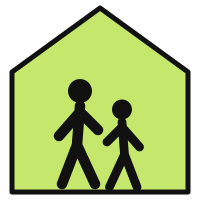 This five-sided yellow-green sign marks a school zone. Slow down, use extra caution and watch for children.
- School zone signs are five-sided with a fluorescent yellow-green background, so they stand out from other warning signs.
-
Without the crosswalk, the sign marks a school zone, not a specific crossing. Children may be anywhere along the road.