Handbook study course › Safe and Responsible Driving
Sharing the road
Pedestrians, cyclists, motorcycles, large trucks, buses and farm vehicles: who needs extra space, and how to pass them safely.
25 key points from this part of the handbook. Read them, then practise; every point comes from the explanation of one of our practice questions.
- A motorcycle is entitled to the full lane. Never share its lane; pass only by moving into another lane when it is safe.
- Large vehicles swing wide to clear the curb. If you move into the gap on the right, you can be squeezed between the trailer and the curb.
- When a large vehicle's driver releases the brakes after stopping, it may roll back. Leave plenty of space in front of you.
-
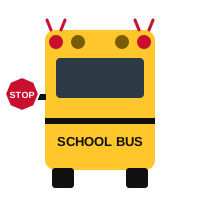 Without a median, drivers in both directions must stop for a school bus with flashing red lights or its stop arm out. Wait until the bus moves or the signals are turned off.
-
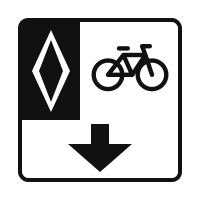 You may enter or cross a bike lane to turn right, but check your blind spot for cyclists and enter only when it is safe.
-
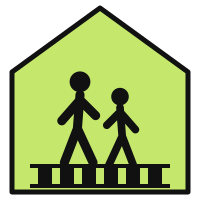 At a school crossing with a guard, stop and yield the whole roadway. Go only after everyone is off the road.
- Cyclists usually ride about 1 m from the curb, but they may use any part of the lane when needed: to avoid hazards, to cross tracks at a right angle, or to discourage passing in a lane too narrow to share.
- Cyclists usually ride about 1 m from the curb, but they may use any part of the lane to avoid hazards or to stop unsafe passing. Be patient and change lanes to pass.
-
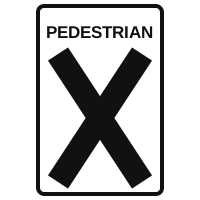 At pedestrian crossovers, drivers must stop and yield the whole roadway, and go only when the pedestrian is safely on the sidewalk.
-
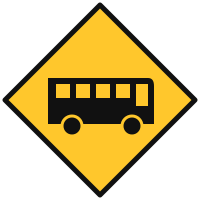 On a road without a median, drivers approaching from either direction must stop for a school bus with flashing red lights.
- Drivers must keep at least 1 m between their vehicle and a cyclist when passing, where practical. Failing to do so can bring a fine and demerit points.
- The slow-moving vehicle sign warns that the vehicle travels 40 km/h or less. Slow down, stay well back and pass only when it is safe.
-
When you approach a school bus from behind and its red lights are flashing or its stop arm is out, stop at least 20 m away. This gives children room to cross safely.
- Drivers must leave at least 1 m between their vehicle and a cyclist when passing, where practical. Failing to do so can bring a fine and 2 demerit points.
-
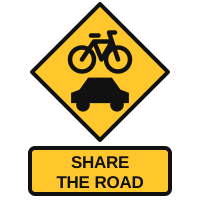 Ontario drivers must keep at least 1 m between their vehicle and a cyclist when passing, where practical.
-
When approaching a stopped school bus with red lights flashing from behind, stop at least 20 m away.
- Drive slowly and with extra care in school zones, residential areas and anywhere children may be walking or playing. A child may run onto the road without warning.
- People who are blind or have a visual disability may use a white cane or guide dog. Be patient and ready to stop for them at intersections.
- Check your mirrors and look over your shoulder for passing cyclists before opening a door, so you do not open it into their path.
- Where possible, change lanes to pass a cyclist. If you must share the lane, leave at least 1 m between your vehicle and the cyclist where practical.
- Trucks have large blind spots on both sides and behind. If you can't see the driver's face in their side mirror, the driver can't see you.
- Large commercial vehicles need much more distance to stop. If you cut in close and then slow down, the truck may not be able to stop in time.
-
Bike lanes are reserved for cyclists. Drivers should stay out of them, except when needed to turn right.
- A bike box lets cyclists wait ahead of traffic. Drivers must stop for the signal behind the bike box and must not stop in it.
- A vehicle stopped at a crosswalk may be letting a pedestrian cross whom you cannot see. Do not pass it.