Handbook study course › Safe and Responsible Driving
Driving along
Speed limits, following distance, looking well ahead and keeping right: the habits of everyday driving.
13 key points from this part of the handbook. Read them, then practise; every point comes from the explanation of one of our practice questions.
- When no limit is posted, the maximum is 80 km/h outside cities, towns and villages. Inside them it is 50 km/h.
-
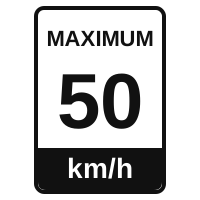 Where no limit is posted, the maximum is 50 km/h in cities, towns and villages, and 80 km/h elsewhere.
-
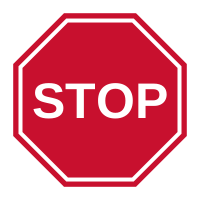 You must follow a police officer's directions, even when they differ from traffic signs or lights.
- Where no limit is posted, the maximum is 50 km/h in cities, towns and villages. Outside those areas it is 80 km/h.
- Stay at least two seconds behind the vehicle in front in ideal conditions, and leave more space in bad weather or behind motorcycles and large trucks.
- A posted limit is the maximum, not a target. In bad weather, heavy traffic or construction zones, drive below it so you can always stop safely.
- As a general rule, drive at about the same speed as the traffic around you without exceeding the posted limit. Driving so slowly that you block the normal flow of traffic is also unsafe.
- Keep to the right, or in the right-hand lane on multi-lane roads, especially when you are slower than other vehicles. This leaves the left lanes free for passing.
- If your signal lights fail, use arm signals: left arm straight out for a left turn, bent up for a right turn, and bent down for slowing or stopping.
- Radar detectors and other speed-measuring warning devices are illegal in Ontario. If you are caught with one, you can be fined and get demerit points.
- If your front bumper reaches the fixed marker before you finish counting to two seconds, you are too close. Slow down to increase the gap.
-
The posted limit is the most you may drive in good conditions. In bad weather, heavy traffic or construction, drive below it.
-
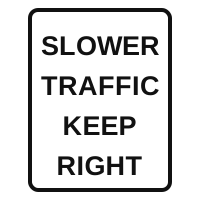 Keep to the right lane on multi-lane roads unless you are going to turn left or pass. When a left turn is coming, move left when it is safe.