Most-missed G1 questions, explained
These are the questions that trip people up, with the right answer and why. Read the explanation even when you would have got it right: the wrong answers are written to look reasonable.
Regulatory signs
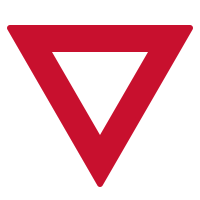
What does this sign mean?
- Come to a full stop every time, even if the road is clear.
- You have the right-of-way over cross traffic.
- Merge into traffic without slowing down.
- Let traffic in or near the intersection go first, and stop if necessary. (Correct answer)
Explanation: A yield sign means other traffic goes first. Slow down, stop if you need to, and go only when the way is clear.
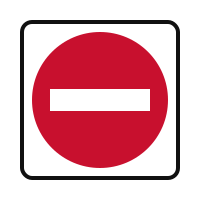
What does this sign mean?
- Do not enter this road. (Correct answer)
- No stopping at any time.
- One-way road ahead; enter with care.
- Road closed to trucks only.
Explanation: This sign means you must not drive into the road. It is often placed where entering would mean driving the wrong way.
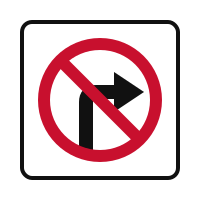
What does this sign mean?
- No right turn on a red light only.
- Right turn only.
- No right turn at this intersection. (Correct answer)
- Keep right of the island.
Explanation: The red circle and slash over a right arrow means right turns are not allowed here, whatever colour the light is.
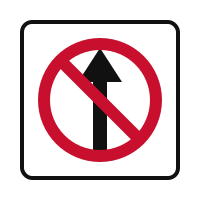
What does this sign mean?
- Straight ahead only.
- Do not drive straight through the intersection. (Correct answer)
- One-way road ahead.
- The speed limit changes ahead.
Explanation: The red circle and slash over an upward arrow means you may not go straight through this intersection.
Warning signs
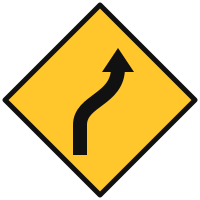
What does this sign mean?
- A gentle curve to the right ahead (Correct answer)
- A side road joins from the right ahead
- Right turns only from this lane
- A sharp right-angle turn ahead
Explanation: A curved arrow warns of a slight bend in the road. A right-angle arrow would warn of a sharp turn instead.
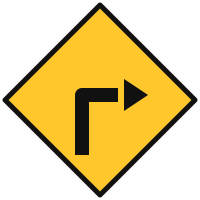
What does this sign mean?
- A gentle curve to the right ahead
- Right turns are allowed only at the next light
- The right lane ends ahead
- A sharp turn to the right ahead (Correct answer)
Explanation: The right-angle arrow means the road turns sharply. Slow down more than you would for an ordinary curve.
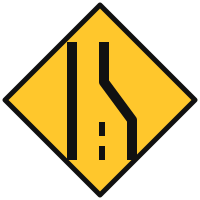
What does this sign mean?
- The left lane ends ahead
- The right lane ends ahead (Correct answer)
- Two roads join ahead
- The pavement narrows ahead
Explanation: The right edge line bends in to meet the lane beside it. Drivers in the right lane must merge left.
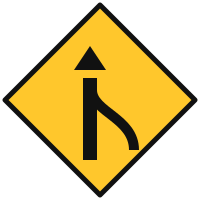
What does this sign mean?
- A road branches off to the right
- The right lane ends ahead
- Two roads going the same way are about to join (Correct answer)
- A divided highway begins ahead
Explanation: The curved line joining the straight arrow shows traffic from another road entering yours. Expect vehicles to merge.
Construction signs
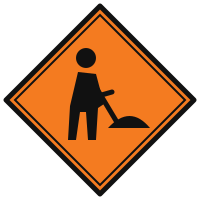
What does this sign mean?
- Survey crew working ahead
- Pedestrian crossing ahead
- Road work ahead (Correct answer)
- Traffic control person ahead
Explanation: A worker with a shovel on an orange sign means people are working on the road ahead. Slow down and watch for workers and equipment.
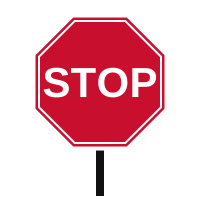
A traffic control person holds up this sign. What must you do?
- Slow down and drive around the worker
- Stop, then go when the road looks clear
- Stop before reaching the person and wait until the STOP sign is no longer shown (Correct answer)
- Yield to oncoming traffic and keep going
Explanation: A STOP sign shown by a traffic control person means you must stop and stay stopped until they stop showing it. Disobeying it is an offence.
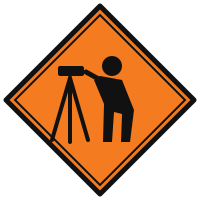
What does this sign warn you about?
- A survey crew working on or near the road ahead (Correct answer)
- Road work with digging ahead
- A speed camera ahead
- A traffic control person ahead
Explanation: The figure looking through an instrument on a tripod is a surveyor. A survey crew is working on or beside the road, so slow down and watch for people.
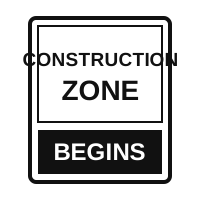
What does this sign mean?
- The construction zone ends; resume normal speed
- The road ahead is closed to all traffic
- Only construction vehicles may go past this point
- You are entering a construction zone; drive with extra caution and expect a lower speed limit (Correct answer)
Explanation: This sign marks the start of a construction zone. Drive with extra caution and be prepared for a lower speed limit.
Signals & road markings
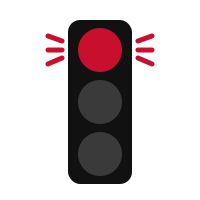
What must you do at this flashing red light?
- Slow down and go through with caution without stopping
- Come to a complete stop and go only when it is safe (Correct answer)
- Stop only if traffic is coming from your right
- Stop and wait until the light turns green
Explanation: A flashing red light works like a stop sign. Stop completely, then go when the way is clear; it will not turn green.
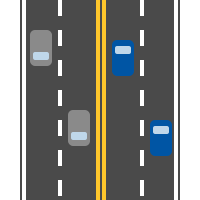
What do yellow lines on the road separate?
- Lanes of traffic going the same direction
- Bicycle lanes from car lanes
- Parking spaces from traffic lanes
- Traffic travelling in opposite directions (Correct answer)
Explanation: Yellow lines separate traffic going in opposite directions. White lines separate lanes of traffic going the same direction.
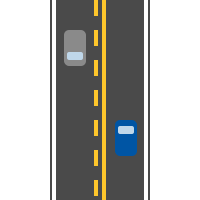
You are driving the blue car. The centre line on your side is solid. May you pass?
- No; a solid line on your side means it is unsafe to pass (Correct answer)
- Yes, if the car ahead is driving slowly
- Yes, but only in daylight
- Yes, if you sound your horn first
Explanation: A solid line at the left of your lane means passing is unsafe there. You may pass only where the line on your side is broken and the way is clear.
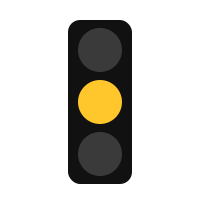
The light ahead turns yellow. You are far enough back to stop safely. What should you NOT do?
- Check your mirror for traffic behind
- Brake smoothly
- Stop at the stop line
- Speed up to get through before it turns red (Correct answer)
Explanation: A yellow light means stop if you can do so safely. Speeding up to beat the red light is dangerous and can end with you running the red.
Right-of-way & turns
A pedestrian is crossing at a pedestrian crossover. When may you drive on?
- When the pedestrian reaches the centre of the road
- As soon as the pedestrian has passed your lane
- Only when the pedestrian has completely crossed and is on the sidewalk (Correct answer)
- When the overhead lights are still flashing but the way looks clear
Explanation: At a pedestrian crossover you must yield and wait until pedestrians have completely crossed the road and are safely on the sidewalk.
You want to pass a motorcycle that is riding in your lane. How should you do it?
- Squeeze past it within the same lane
- Change lanes and pass, as you would any other vehicle (Correct answer)
- Pass it using the shoulder
- Drive beside it in the lane until it moves over
Explanation: A motorcycle is entitled to the full lane. Never share its lane; pass only by moving into another lane when it is safe.
At an all-way stop, you and a car on your right come to a complete stop at the same time. What should you do?
- Go first because you are on the left
- Go first if you are driving straight
- Let the car on your right go first (Correct answer)
- Sound your horn and go together
Explanation: When two vehicles stop at an all-way stop at the same time, the vehicle on the left yields to the vehicle on the right.
Does turning on your signal give you the right-of-way?
- Yes, once you signal others must let you in
- No, you must still make sure the way is clear (Correct answer)
- Yes, if you signal for at least five seconds
- Yes, but only when changing lanes
Explanation: Signalling only tells others what you plan to do; it does not give you the right-of-way. Check that the way is clear before you move.
Speed limits & parking
No speed limit is posted on a road outside cities, towns and villages. What is the maximum speed?
- 80 km/h (Correct answer)
- 60 km/h
- 70 km/h
- 50 km/h
Explanation: When no limit is posted, the maximum is 80 km/h outside cities, towns and villages. Inside them it is 50 km/h.
You drive far below the speed of traffic for no good reason, holding up other drivers. What offence can this be?
- Unnecessary slow driving, with 2 demerit points (Correct answer)
- Stunt driving
- Careless driving, with 6 demerit points
- None; slow driving is always legal
Explanation: Unnecessary slow driving is an offence worth 2 demerit points. Drive at about the speed of traffic without going over the limit, and slow down when conditions require it.
You are between two "No Stopping" signs. May you stop for a moment to let a passenger out?
- Yes, if your hazard lights are on
- Yes, to let passengers out only
- No; you may not stop there, even for a moment (Correct answer)
- Yes, for up to 3 minutes
Explanation: In a no-stopping area you may not stop at all, not even briefly. A no-standing area lets you stop only to load or unload passengers.
You must not park within how many metres of an intersection with traffic lights?
- 6 m
- 9 m
- 12 m
- 15 m (Correct answer)
Explanation: At an intersection controlled by traffic lights, do not park within 15 m. At other intersections the distance is 9 m.
G1 rules & demerit points
When may a G1 driver drive on a 400-series highway?
- When traffic is light
- When the accompanying driver is a driving instructor (Correct answer)
- On weekends, in daylight
- When the accompanying driver has 10 years of experience
Explanation: The highway restriction is lifted only when the accompanying driver is a driving instructor; then a G1 driver may drive on any road.
After completing an approved driver education course, how long must you hold a G1 before the G2 road test?
- 4 months
- 6 months
- 10 months
- 8 months (Correct answer)
Explanation: A government-approved driver education course shortens the G1 period by four months, from 12 months to 8 months.
Ontario's zero tolerance rules for novice drivers and drivers 21 and under apply to:
- Alcohol only
- Both alcohol and drugs, including cannabis (Correct answer)
- Cannabis only
- Alcohol only, between midnight and 5 a.m.
Explanation: G1, G2, M1 and M2 drivers and all drivers 21 and under must have no alcohol and no drugs, including cannabis, in their system when driving.
What happens when a novice driver reaches 9 or more demerit points?
- A 60-day licence suspension (Correct answer)
- A 30-day licence suspension
- A fine only
- A warning letter only
Explanation: A novice driver with 9 or more points has their licence suspended for 60 days. Fully licensed drivers are suspended at 15 points.
Safe driving & conditions
If you are using high beams, within what distance of an oncoming vehicle must you switch to low beams?
- 300 m
- 200 m
- 250 m
- 150 m (Correct answer)
Explanation: Switch to low beams within 150 m of an oncoming vehicle so the glare does not blind its driver.
Which headlights should you use when driving in fog?
- Low beams (Correct answer)
- Parking lights only
- Daytime running lights only
- High beams
Explanation: High beams reflect off the water droplets in fog and make it harder to see. Use low beams, plus fog lights if you have them.
When the temperature drops below freezing, which parts of the road usually freeze first?
- Sunny, open stretches of highway
- Bridges, overpasses and shaded areas (Correct answer)
- Busy city intersections
- Newly paved roads in direct sunlight
Explanation: Wet roads on bridges, overpasses and in shaded areas freeze first. Look ahead and slow down before you reach them.
Your car starts to skid on a slippery road. What should you do?
- Ease off the gas or brake and steer in the direction you want to go (Correct answer)
- Turn the wheel sharply the opposite way from where you want to go
- Brake as hard as you can and hold the wheels locked
- Speed up quickly so the tires regain their grip
Explanation: Stay calm, ease off the accelerator or brake, and steer where you want the vehicle to go without oversteering.